The Legible Few
The Failure of the Elite, Part II

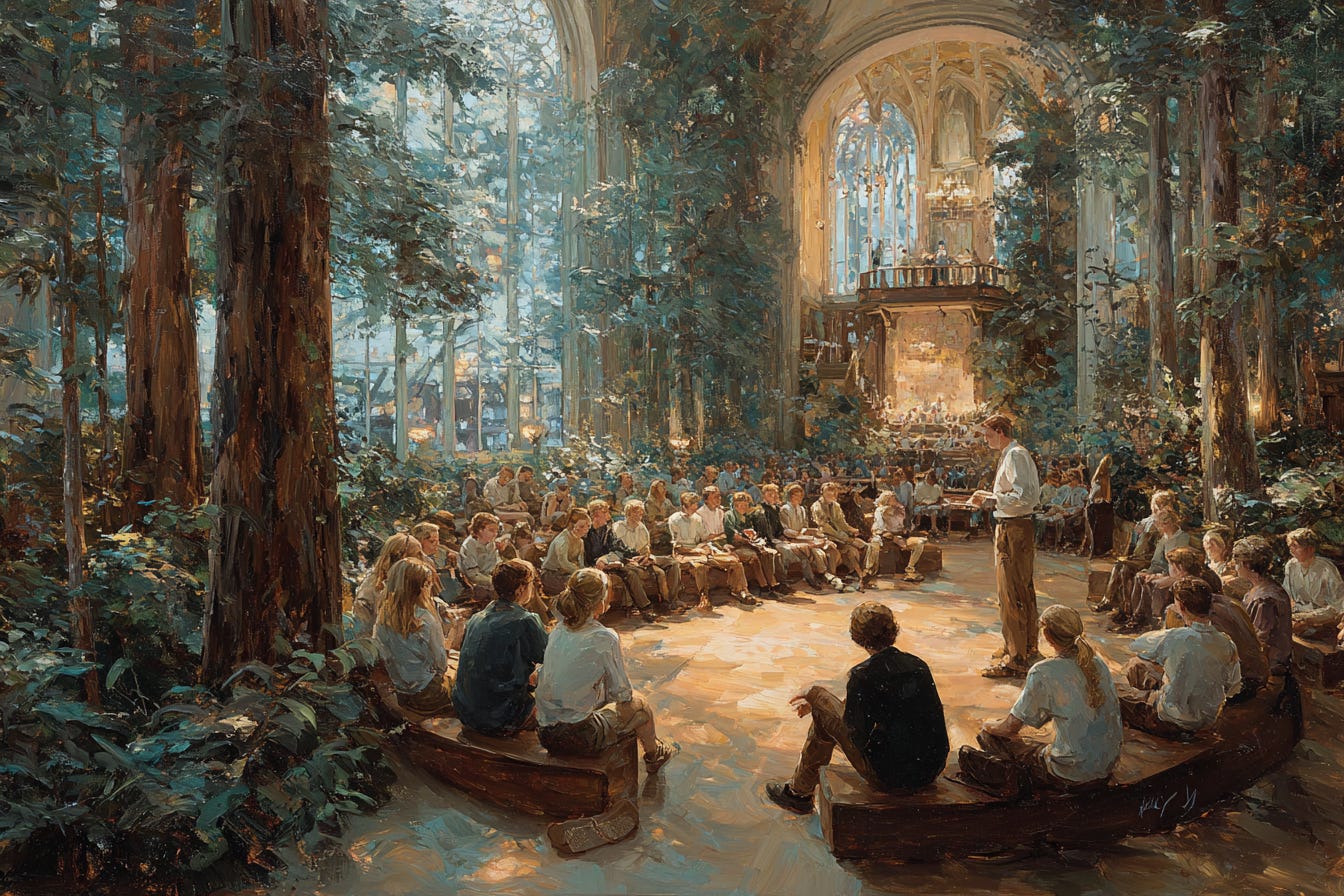
In Part I, we made the case that what we are facing isn’t a loneliness epidemic: it’s a shame epidemic. The distinction is structural. Loneliness pushes people toward connection whereas shame produces withdrawal. A lonely person calls a friend. An ashamed person cancels the plan. But the shame we described isn’t personal. It’s the experience of failing against a standard by which you can no longer define. It is produced by elites who still hold power but have abandoned the function that made that power legible. Not perfectly. Not justly. But legibly. The standard was a recognizable map: here is how you earn standing, here is how you lose it. And having a standard to push against is itself a form of orientation.
What makes today different isn’t simply elite failure. It’s that today’s most powerful elites operate in the two domains least constrained by institutional norms — culture and technology — and they have stopped producing any coherent standard at all. The result isn’t counter-culture. It’s confusion. And confusion does something specific: when you cannot identify the standard you’re failing to meet, you cannot locate the failure outside yourself. The system disappears. Only your inadequacy remains.
We closed with the harder question: if the diagnosis is right, what do we do about it?
This is Part II.
We have three proposed answers:
The first is a call for a new kind of elite — and a counter-elite with enough credibility to hold it accountable.
The second is what we’re calling Engines of Purpose: intermediaries that help people explore meaning without having to become elite to access them.
The third is a new operating agreement, what J.S. Mill called the collision of adverse opinions with the conditions under which disagreement stays productive instead of becoming dissolution.
We need a new elite bloc — and a counter-elite that holds it accountable
The new exemplar
Every era produces its own elite. And every elite tells a story to justify itself.
The last era was defined by what we’ll call the Builder: the decentralizer, the disruptor, the builder of platforms and movements. That archetype made sense in a world where institutions were bloated, captured, and stagnant.
But we believe the next era will likely swing toward something else: a hunger for coherence. Not nostalgia. Not a return to anything specific (that hasn’t been working). A deep, cross-partisan exhaustion with having to construct meaning from scratch — and a growing appetite for standards that hold long enough to orient a life around.
We mean something deeper than a mood/vibe: a cultural reassertion of stability, duty, family, faith, and shared moral language. Not because everyone becomes religious, but because people become exhausted and seek meaning. Exhausted by choice. Exhausted by incoherence. Exhausted by having to invent themselves from scratch every season. Gen Z’s most durable “cores” — old money, dark academia, coastal grandmother — are not style choices so much as fantasies of inherited pre-packaged identity: a self that arrives pre-assembled with a history, a set of obligations, and a legible standard to meet or reject. And in Alpha, the signal arrives earlier and at a more fundamental moment: a child who spends hours customizing a Roblox avatar — engineering a self from scratch before adolescence — may be doing identity construction that the absence of a stable elite standard has pushed all the way down into childhood.
Conservatives want this shift because the last few decades feel like moral free-fall. A coherent standard offers what they’ve been asking for: norms that hold.
Liberals want it too. They won the culture wars on identity in many domains, but lost the deeper war on meaning. A decade of enforcing morality through social pressure and cancellation revealed an uncomfortable truth: moral policing without moral consensus doesn’t liberate anyone. You don’t get freedom. You get exhaustion, fragmentation, and shame.
The liberal project isn’t failing because it lost power. Enforcing norms while remaining officially agnostic about the good life doesn’t produce neutrality — it produces a moral culture that speaks in everyone’s name and carries no one’s values.
The elite bloc of the next era will likely combine:
• cultural capital (to set norms people actually follow)
• technical capital (to build scalable infrastructure using AI and networks)
The next standard-setting class won’t just govern. They’ll shape the culture and aspiration layer and they’ll do it with technology.
The question every era has to answer is: who should we look up to, and why? In classical Athens, the philosopher had neither wealth nor armies, but Socrates was the exemplar. Medieval Europe had merchant elites and warrior elites, but the cultural exemplar was the saint: the person who embodied the highest human possibility. Proximity to God, not gold, conferred that status.
We believe AI makes intelligence cheap and abundant, the person who embodies something AI cannot replicate becomes the new cultural exemplar.
In Kant’s Groundwork, he drew a line that cuts directly across what AI is doing right now. Things that have price are exchangeable, substitutable, replaceable and AI is collapsing the price of intelligence toward zero. But things that have dignity cannot be priced because they are irreplaceable ends in themselves. For most of history, human labor had a price. AI is now bidding that price down aggressively. The question is whether the people who hold power will respond by doubling down on what has dignity or by accelerating the substitution of everything that does.
The first act of rebuilding aspiration is making a deliberate, public, stubborn choice about who we celebrate. That means the new elite bloc must spend some of their cultural and technological capital elevating a different kind of hero. Not because it is altruistic. But necessary for the society they are trying to build to hold together.
Part I named the vacuum. Part II has to answer the hardest question it left open: who enforces this? Not elections. Not regulators.
The Church did not invent this problem — but it has watched elite abdication long enough to recognize its shape, and to notice that the usual enforcement mechanisms are missing. What’s new is that even the Church, the institution that has outlasted every previous elite formation, is now naming this moment as structurally distinct. Pope Leo XIV’s encyclical Magnifica Humanitas, released this week, called for “discrediting the assumption that technical power automatically confers the right to govern.” Political power has elections. Economic power has regulators. Cultural and technical power have neither.
The Accountability Stack
What enforces a standard when institutions can’t is a stack — three layers, each weak alone and stronger in combination.
The first layer is reputational. When formal legal mechanisms don’t apply — which is exactly the condition Part I described for cultural and technical elites — trust built in public, over time, becomes the currency. This is why Dario Amodei has a different cultural standing than some of his peers. It is not a policy. It is a consistent record.
The second layer is the counter-elite as a punishment mechanism. Reputation only constrains behavior when someone is watching closely enough to notice when the record breaks. The healthy counter-elite is the infrastructure that makes hypocrisy costly. Tocqueville called the lateral pressure of shared civic habits the mores, and was clear they were enforced not by the government but by neighbors watching neighbors.
The third layer is commitment architecture — what the exemplar does to tie their own hands. Historical elites made responsibility binding through acts that were public, specific, and costly to reverse. The Medici commissions had the family name on them. Carnegie’s libraries had his. Once you have publicly attached yourself to a standard, stepping back from it becomes a visible failure rather than a private choice.
Seriousness as a practice
The new exemplar is not just a different type of person. They actually behave differently. The last elite cycle rewarded performance: personal branding, managed relatability, curated vulnerability. What’s emerging now is a hunger for people who simply mean what they say. People who distinguish between expertise and credential, between substance and its simulation — and who hold that line even when it costs them something.
The 2025 Edelman Trust Barometer found that 69% of respondents now believe government officials, business leaders, and journalists deliberately mislead them, up 11 points since 2021. The distrust of business leaders specifically has risen 21% over that same period.
In the Rhetoric, Aristotle defines ethos as the credibility a speaker earns through demonstrated character over time — not claimed authority, but accumulated trustworthiness. A person who claims to be honest while behaving otherwise doesn’t just fail to persuade; they undermine trust more thoroughly than a known liar, because they’ve shown they understand the moral norms well enough to exploit them. The new exemplar earns authority by closing the gap between what they say and what they do. That is not a personality type. It is a discipline.
This is also why the counter-elite’s ethos matters beyond persuasion: in Aristotle’s account, shame is specifically the fear of censure before those whose judgment we respect — which means only a credible counter-elite can make elite hypocrisy feel costly rather than merely visible.
Dario Amodei is the clearest current case on the technical-capital side. He holds enormous resources, runs one of the three AI labs that will shape the next decade, and has behaved as though the burden of that position is real — writing long-form essays on civilizational risk, declining Pentagon contracts for domestic surveillance, insisting publicly on costs his own industry is creating. Imperfect, but visibly so. That is the difference. Authority, in this register, is not a claim. It is an accumulation.
The same pattern appears on the philanthropic side in MacKenzie Scott. What makes her legible as an exemplar is not the scale of her giving, it is the architecture of it. No foundation bearing her name. No press releases. No donor-advised fund quietly warehousing capital while she decided. Just money out the door, at scale, to organizations chosen by a methodology she’s described publicly.
What both share is a willingness to make the cost of their position visible rather than obscuring it behind institutional distance.
The cultural side of this equation has its own exemplar in Daniel Day-Lewis. He holds enormous influence and has spent that influence with unusual consistency. His films are not performances that gesture at depth; they are sustained investigations into specific things: the psychology of obsession (There Will Be Blood, Phantom Thread), the cost of will (My Left Foot, The Last of the Mohicans), the way a person’s interior architecture either holds or collapses under historical pressure (Gangs of New York, Lincoln, In the Name of the Father). Those investigations have been specific enough, and consistent enough, to be held against him, which is exactly what commitment architecture requires. Between major roles he became a shoemaker’s apprentice in Florence — not as aesthetics, not as content for an interview, but as the actual practice of a discipline that has nothing to offer the celebrity machine. The largest commercial platforms available to a working actor — franchise films, streaming prestige projects, endorsements — he declined across four decades. When he left acting in 2017, he said the work had left him “feeling hollowed out,” and he treated that as a reason to stop, not as a feeling to manage. What makes him legible in this framework is not the three Academy Awards but what he has declined to do with them. In an era when cultural capital almost automatically converts into the kind of performance that hollows out the original claim, that refusal is itself the signal. The exemplar doesn’t always build more. Sometimes the most legible thing they do is nothing new.
What they refuse to build
The most underasked question in elite circles right now is not “what will you build?” It is: what will you refuse to build?
Sultan Qaboos of Oman faced a version of this question when oil wealth threatened to flatten centuries of Omani culture into generic Gulf modernism. His answer was deliberate: he decided what Oman would not become, and built that refusal into the architecture of the state itself. Literally. His directives required that all new construction incorporate traditional Omani architectural elements: the arched doorways, the carved wooden screens, the low-rise profiles native to the region. Not as ornament but as a policy. The result is one of the few countries that came through a resource windfall still feeling like somewhere — a place with a rooted identity, rooted in its own history, not assembled from global capital’s default settings. It is not a perfect outcome. But it is proof that the choice is available.
This is a non-ideological frame. It is neither conservative nor progressive. It does not ask elites to stop building. Instead, it asks them to build with intention, to treat restraint as a form of power rather than a failure of ambition. In an age when AI can generate, scale, and distribute almost anything almost instantly, the capacity to say no — to decline to flood a culture with synthetic content, to decline to optimize for addiction, to decline to replace human relationships with their cheaper simulation — is not weakness. It is the most consequential decision a builder can make.
Remove what stops them

A man asked his gardener why his plants grew so beautifully. The gardener said: “I don’t force them to grow. I remove what stops them.”
This is the right frame for everything that follows. The argument is not that elites should engineer aspiration from above, or that institutions should prescribe meaning, or that someone should hand down a new set of values. People’s capacity for purpose, connection, and ambition is not missing. It is being suppressed.
So what weeds does the gardener actually pull? At minimum:
Recommendation systems built for attention, not growth: algorithms that keep people engaged by feeding them what confirms, provokes, or flatters, rather than what challenges or expands.
A credentialing machine that tells most people they failed: a sorting system whose primary output, for the majority who pass through it, is the quiet message that they did not make the cut.
The conversion of serious thinkers into performers: an incentive structure that punishes depth and rewards the version of an idea that travels fastest on a timeline.
Synthetic connection in place of actual relationship: infrastructure that lets people feel accompanied while remaining, in practice, alone.
The disappearance of shared physical space: the erosion of the rooms where strangers used to become neighbors without anyone organizing it.
The job is not to build a better aspiration machine. The job is to stop doing what we are currently doing to people, and then get out of the way.
The check: a healthy counter-elite
None of this works without the second half of the equation. An elite that takes responsibility seriously requires a credible challenger class — not to destroy it, but to make its responsibility legible, contestable, and real. That is what counter-elites have always done. What they look like now is different. What they must do is not.
The question is not how to restore the old counter-elites. Unions in their 20th century form, legacy newspapers, mainline churches are not coming back in the shapes we knew them. The question is: who fills the functions they once served, and how?
Those functions were three: voice (the ability to name what power is doing and make it legible to the public), leverage (the ability to impose real costs on bad behavior), and belonging (the ability to give ordinary people a collective identity not mediated by the powerful). New counter-elites will look different, but they must serve the same functions.
Some early shapes are visible, at least for voice. The intellectual who goes deep on niche subjects, builds an audience around genuine expertise, and creates new forms of sensemaking outside legacy institutions is a real and growing phenomenon. 3Blue1Brown has built an audience of millions doing pure mathematics on YouTube with no personality, no controversy, just sustained explanations of difficult things done with unusual care. Scott Alexander’s Astral Codex Ten runs on a single practice: taking ideas seriously, steelmanning opposition, and publishing conclusions that regularly embarrass his own prior positions. The audience trusts him because the work is falsifiable. 404 Media, four journalists who left Vice, has produced accountability reporting across technology, surveillance, and labor that has been cited in congressional hearings.
Leverage and belonging are harder: no distributed network has yet found a reliable way to impose costs on institutional power or to generate the solidarity that a union hall or a parish once did. That remains the open problem.
The clearest recent proof that it can be solved comes from Hungary. For fifteen years Viktor Orbán held power by hollowing out civil society and capturing roughly eighty percent of the country’s media, the textbook conditions under which a spiral of silence takes hold. In small towns especially, people who opposed him assumed they were alone, and that assumption was self-reinforcing: the less anyone signaled dissent, the less safe it felt to be the first. Then something modest started happening in the places Orbán had counted on most. Small civic groups began forming, called Tisza Islands, named for the opposition party but not run by it. What did they do? Mostly banal things. They organized litter pickups and painted bus benches. They held cooking competitions and movie nights. They distributed water in the heat and collected school supplies. And in April, the party they were loosely affiliated with won two-thirds of Parliament in an election almost no one had thought winnable a year earlier.
The islands worked because they served all three counter-elite functions at once. They produced their own local newspapers, which countered Orbán’s propaganda in a way that imported liberal pamphlets never had, because the people making them were neighbors rather than outsiders. That is voice. They created enough visible company that an ordinary person could break with the ruling party without feeling singled out. That is belonging. And by reminding people that no one in power is there permanently, they converted private doubt into a public fact, which is the beginning of leverage. The mechanism was not persuasion. It was proximity. People discovered, by gathering in a room over something concrete, that they were not alone, and that discovery was enough to end the spiral of silence.
This is the counter-elite in its oldest and most durable form. Not an intellectual with an audience, but a network of people doing unglamorous things together until citizenship starts to feel possible again. It is worth noticing that Orbán himself built his original power base this exact way, through “citizens’ circles” in the 2000s, and that when those circles dissolved after he took power, the hunger for them never did. The form is available to anyone. The question is only who picks it up.
Counter-power in the AI age will run on trust built in public, over time, through consistency — which is what Aristotle meant by ethos in the Rhetoric: the credibility a speaker earns through demonstrated character, not claimed authority. The new counter elite is not a class. It is a practice. And the question for anyone with a platform, resources, or reach right now is whether they are investing in that practice or extracting from it.
Elite from above, counter elite from below. That pairing is not rhetorical. It is the mechanism. Without the second half, the first half is just aesthetics.
But here is the thing we have been circling without saying directly: this is not a new problem, and we are not the first people to solve it.
The monastery, the parish, the mosque, the synagogue. Structurally, these were the complete answer to everything this piece has been trying to reconstruct. They set the standard. They modeled the exemplar. They produced the counter-elite: the priest, the rabbi, the imam who could look the powerful in the eye and name the gap between what they claimed and what they did. And they provided, in a single institution, every function we have been arguing needs to be rebuilt: the cultivation of taste through liturgy and architecture, the formation of the young through rite and education, a framework for interpreting the world, a structured opportunity for service, and a room you showed up to every week with people you did not choose and could not easily leave.
We are not arguing for religious revival. But something tends to get lost in secular institution-building: what we are trying to reconstruct was not just a set of functions. It was a story — a coherent account of why any of it mattered, why the standard was worth meeting, why the person across from you deserved your patience and your honesty and your presence.
The functions can be rebuilt without the story. But they will be harder to sustain.
That is the question Part III - which will be released on Thursday - takes up.
found it incredibly satisfying to see what so many of us have been feeling & observing put to words! was hoping to see an encyclical reference and ya'll didn't disappoint....
one of the stats I find incredible that support this overall craving for meaning thesis (beyond the resurgence of christian religiosity and conservatism in San Francisco) os that about 40% of the nearly 4m users on Hallow are not Christian-identifying