Rooms, Neighbors, Time
The Failure of the Elite, Part III

The prevailing elite and the counter-elite give a society something to aim for. They do not give people meaning. Those are different problems — and conflating them is how every top-down reform movement eventually loses the people it was trying to reach.
The question is simpler to state than to answer: even if we fix the top, how does aspiration travel down?
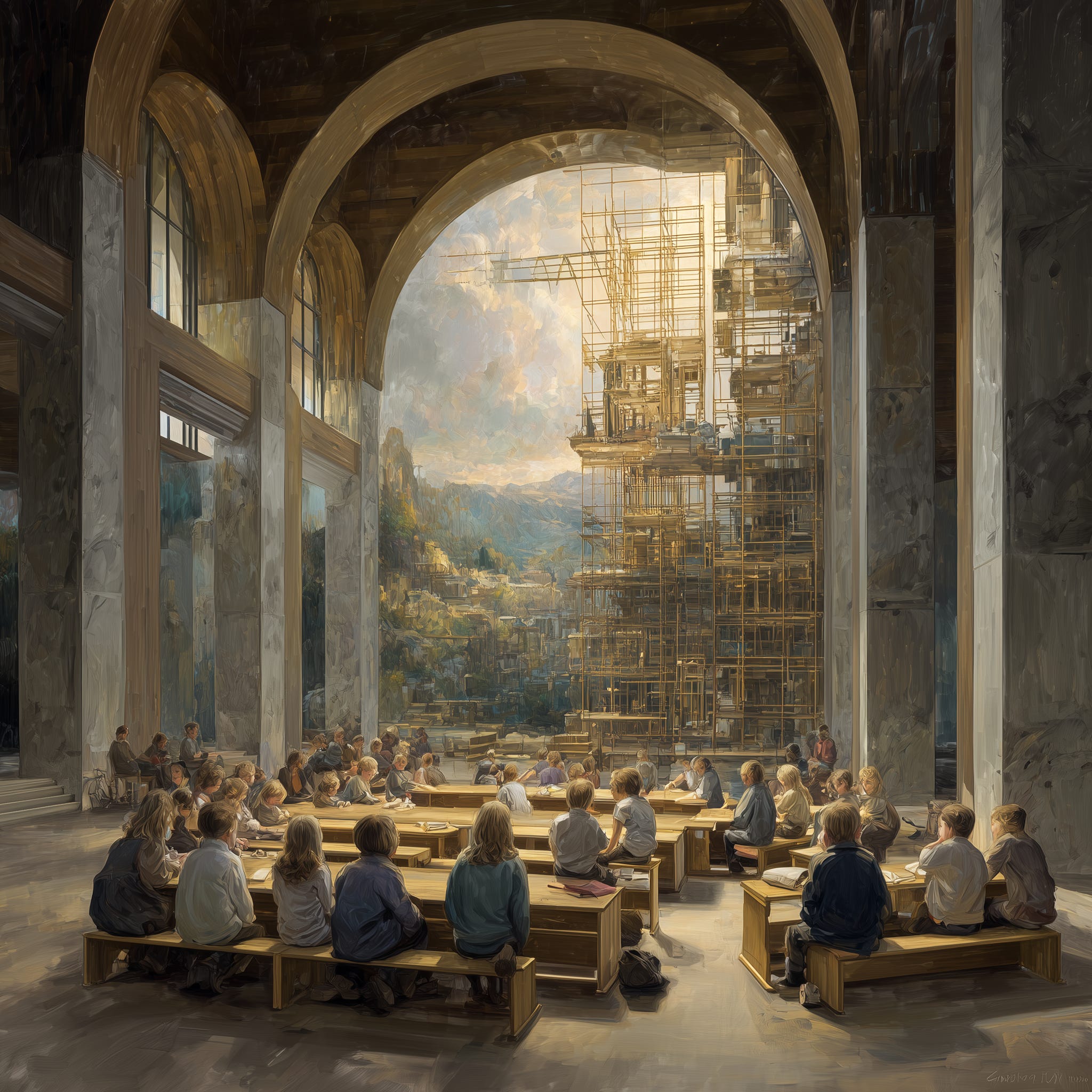
Five engines. Each addresses a distinct failure. Together they form a sequence: taste sets the cultural precondition; education develops it before the algorithm can capture it; AI literacy protects it once they’re old enough to be exposed; national service channels it toward usefulness and toward other people across lines of class and geography; proximity provides the physical substrate without which all the others stay abstract. You cannot build a culture of aspiration in the air. You build it in rooms, with neighbors, over time.
Engine #1: Taste as civic infrastructure
When Silicon Valley starts talking about taste, that’s the tell: they’re hunting for something they don’t have. Greg Brockman, president of OpenAI, recently posted that “taste is a new core skill.” Mark Zuckerberg front row at Prada. Jeff Bezos and Lauren Sanchez chairing the Met Gala. People only go looking for things they don’t have.
But the hunger for taste is not superficial. It is a symptom of something deep.
Pierre Bourdieu, argued that taste is not personal preference. It is how class reproduces itself, how people signal alignment, how societies communicate shared values without having to state them explicitly. To have taste is to hold something like the mandate of heaven: an alignment of perspectives and values, a shared morality, a credible claim to set the standard.
The challenge is that AI can generate everything except genuine taste. It can produce infinite content, but it cannot have a point of view that is at stake. It can mimic the aesthetics of memory without the inconvenience of lived experience. The result is a world drowning in AI slop.
The Vienna Secessionists in 1898 faced the same problem and built the template for answering it. Their motto was Der Zeit ihre Kunst, Der Kunst ihre Freiheit (”To the age its art, to art its freedom”). It was carved above the door of their exhibition hall as a direct rebuke to what they called the “Potemkin City”: a culture that worships dead forms, recycled pastiches, ashes. Their argument wasn’t that tradition was wrong. It was that clinging to traditional forms while abandoning the living spirit that made them vital was the real betrayal. The worship of ashes is not conservatism.
We are building our own Potemkin City right now, only ours is digital. Aesthetic monotony and sterile environments. A collective sensory deprivation that comes from mass-producing the same thing at scale. Our brains need sensory richness, and a world optimized for algorithmic engagement strips it out.
The counter-signal is already visible. Gen Alpha, which is the first generation raised entirely on social media, has the strongest preference of any age cohort for doing things in person. They want to see movies in theaters, watch sports from the bleachers, play video games with friends in the same room. There is a reason the return to analog, to craft, to antiques, to IRL events, to handmade and tangible design is not just a boutique trend. It is a civilizational immune response.
Taste, properly understood, is developed — not consumed. It comes from traveling, from experiencing new places and new people, from going deep rather than wide. In practice, it means spending a week in one town instead of five cities or finishing the novel instead of AI summarizing ten. A book, a city, a tradition: none of them show you anything real on the first pass. They require return visits and contemplation.
Rick Rubin is the clearest current case on the cultural-capital side of this argument. He holds enormous influence in music, and his work — The Creative Act, the long-form podcast conversations, the deliberate stillness — is explicitly about depth and slowness against optimization. He has become a kind of secular wisdom figure not by accelerating his output but by refusing to. That refusal is the point. It is the form taste takes when it stops trying to keep up with the algorithm and starts setting a standard the algorithm cannot reach.
This is not a call for elitism or snottiness. It is a call for the democratization of cultivation. Thinking deeply is becoming a luxury good and that is a crisis. If the new renaissance is to be more than a boutique phenomenon for people with reality privilege, then taste must be treated as civic infrastructure: something we invest in at the institutional level, not just something the wealthy stumble into through travel and leisure from a young age.
The engines that follow — schools, arts institutions, cultural programming, service structures — must make cultivation accessible. Not by flattening taste into content, but by creating the conditions (time, exposure, mentorship, beautiful spaces) under which real taste cultivation can develop.
Engine #2: Decentralized education with nurturing at the core
The future belongs to people who were cultivated, not just credentialed. The problem is that the education system we have was never designed for cultivation. It was designed to credential. And credentialism, as we argued in Part I, was meritocracy’s mutation. A system that once rewarded genuine contribution began rewarding the performance of qualification instead. Our current education system is a sorting machine and the sorting machine is now breaking.
That machine failed in two directions simultaneously. For engaged parents with resources, it produced children optimized for test performance and college application narratives. These are the kids who arrived at 18 with high anxiety, low self-knowledge, and no clear sense of what they actually valued. For disengaged or overwhelmed parents without resources, it produced something quieter and more corrosive: children who were never seen by the system at all, sorted into the failure category before they had the language to object. Both failures came from the same source. The machine was running perfectly. That was the problem.The movement that began to answer this did not emerge from policy. It emerged from exhaustion — from both ends of the resource spectrum simultaneously.
Education Savings Accounts (ESAs), now active in over a dozen states, are the most structurally significant development in American education in a generation. They are not vouchers in the traditional sense. They don’t just move a child from one school to another. They unbundle schooling itself: public funds follow the child and can be spent across a portfolio. It can include a microschool for core academics, an apprenticeship program for a craft, a community college course for advanced math, a coding co-op, a wilderness program. Learning is organized around the child.
Howard Gardner, the originator of multiple intelligences, argues that by about 2050 every child would need only a few years of schooling in the Three R’s plus a little bit of coding and we agree with the direction. Not because we want less education, but because we want different education: less conveyor belt, more cultivation.
By middle school, the goal should not be résumé-building. It should be: curiosity, experimentation, skill-building, identity formation, mentorship, and community contribution. That reorientation has practical implications. It means smaller learning environments where adults actually know children by name and over time. It means project-based and apprenticeship models that connect learning to contribution, not just evaluation. It means assessments designed to reveal what a student is becoming, not just where they rank. And it means treating mentorship — the presence of a consistent adult who believes in a specific child’s specific potential — as a non-negotiable educational input rather than a luxury.
The honest challenge is equity. ESAs and microschools, in their current form, largely serve families with the time, information, and proximity to navigate them, which means they risk replicating, and in some cases deepening, existing class stratification. A parent working two jobs cannot easily curate a portfolio education for their child. This is the hard design problem: how do you decentralize education without making cultivation a privilege?
The answer requires making ESA funding generous enough to cover the real costs — transportation, materials, coordination time — and investing in microschool infrastructure in under-resourced communities. The goal is to pull the floor up, not just raise the ceiling.
The deeper point is this: the conventional school system was built to produce a specific kind of worker for a specific kind of economy, and it sorted everyone who didn’t fit that mold into the shame category. The AI economy doesn’t need that worker anymore. It needs people who know what they value, who can learn continuously, who have been mentored rather than merely sorted, and who have some experience of being genuinely useful to someone before they are 22. That is not a luxury curriculum. That is the basic preparation for a life with meaning.
Engine #3: Required AI literacy
Taste sets the cultural precondition. Education develops that taste in the young, before the algorithm can capture it. AI literacy is what protects it once they are old enough to be exposed. It represents the capacity to see the machine shaping your desires before it has finished doing so. Just as myths once guided moral imagination, algorithms now shape what we see, believe, and aspire to. If we are outsourcing culture to code, then AI literacy is not optional: it’s civic infrastructure.
AI literacy isn’t just prompting ChatGPT or automating your calendar. Those are the surface skills. The deeper version is harder and matters more:
how recommendation systems are engineered to shape what you want
how social feeds construct identity before you’re old enough to notice
how algorithmic incentives punish depth and reward outrage
how synthetic media corrodes your ability to distinguish what’s real
how status gets manufactured at scale, and why you feel it anyway
Because if people can’t see the machine shaping their aspiration, they will keep experiencing its output as personal failure.
Engine #4: Mandatory national service
Taste, education, and AI literacy all develop something in the individual. National service is where that development meets the world — where the question shifts from “who am I?” to “who needs me?”. From “what do I get?” to “what did I give?” It is the engine that converts aspiration into usefulness, and usefulness into belonging.
To institutionalize responsibility, national service can provide every young person a structured way to be useful: civic projects, care work, school support, community building.
Because purpose is not just self-expression. Purpose is also usefulness. It is the experience of mattering to something beyond yourself, of being the kind of person whose absence would be felt. And usefulness is one of the most under-valued antidotes to shame. When someone is useful, they don’t have to constantly generate their worth from within. It’s reflected back to them through contribution. Someone relies on them. And being relied upon creates belonging, which is the structural opposite of shame.
Viktor Frankl, documenting survival in the Nazi concentration camps, found that the decisive variable was not physical condition but orientation: the presence of a task, a person, a future that made suffering legible. Those with a why survived conditions that should have been unsurvivable. And Martin Seligman’s learned helplessness experiments showed the inverse: when outcomes are persistently uncontrollable organisms stop trying, even after the conditions change and control becomes available again. National service is not a cure for anomie. But it is a structural antidote to learned helplessness: it creates a category of action whose outcome is legible, whose need is real, and whose result is felt by someone other than yourself.
You don’t find purpose by asking who you are. You find it by discovering who needs you.
The argument for national service is not primarily about patriotism, though it can produce that. It is not primarily about discipline, though it develops it. The argument is simpler and more radical: the attention economy is a world in which you broadcast yourself to strangers who have no particular need for you. The result is an endless performance for an audience that is simultaneously everywhere and indifferent. National service inverts the arrangement. It creates a category of need that is legible, reliable, and immediate. It puts young people in proximity to problems that are not abstract: a flooded road, an underfunded library, an isolated elderly neighbor, a school without enough tutors. It makes the nation something you have served, not just something you inherited.
But here is the argument that goes beyond purpose, and that connects national service to the rest of this piece: it is the only engine we have that forces cross-class, cross-geography contact at scale, before people’s identities fully calcify. Every other engine in this list can be captured by existing class dynamics: taste can be a luxury, education can be stratified, AI literacy can accrue to those already advantaged, even proximity can be engineered by those with resources to choose their neighborhoods. National service, if genuinely universal and genuinely compensated, is the only structural mechanism that makes the shared standard felt, not just articulated. The child of a hedge fund manager and the child of a factory worker, doing real work together, on the same problem, accountable to the same community. That experience doesn’t just build character. It builds the shared moral vocabulary that a pluralistic society needs to stay legible to itself.
The shame epidemic is not equally distributed. The communities hardest hit by withdrawal, cynicism, and nihilism are often the ones most stripped of meaningful roles by economic disruption, automation, and the collapse of local institutions. To offer national service only to those who can afford a gap year is to miss the point entirely. The structure must be funded, compensated, and genuinely accessible, because usefulness is not a privilege. It is a right.
Engine #5: Rebuild proximity — the spatial precondition for everything else
All four engines above require something to work: rooms. Physical rooms, shared rooms, rooms you cannot easily leave. Proximity is not one engine among five. It is the substrate on which all the others depend. Taste without place is content and products. Education without community is instruction. Service without neighbors is logistics. The collision of adverse opinions that J.S Mill describes does not happen on a screen. It happens in a room.
Alexis de Tocqueville, traveling through America in 1831, was baffled and then awed by something he found almost nowhere else in the world: Americans formed associations for everything. When a road was blocked, they formed a committee. When a school needed funding, they organized a campaign. When the church roof leaked, they raised money without waiting for someone in authority to notice. He wrote in Democracy in America that this habit of voluntary, local association was the single most important feature of American democracy. It was more important than its laws, its Constitution, or its geography. It was the immune system of self-government. People who learn to negotiate shared life with strangers on small questions develop the capacity to negotiate on large ones.
We didn’t destroy it maliciously. We built interstates that made proximity optional. We built suburbs that made neighborhoods unnecessary. We built social media that made physical presence feel redundant. We got efficiency, convenience, and choice. And we also got the most socially isolated population in recorded history.
The associational hunger is not gone. It is self-organizing, quietly, in the margins. Run clubs replacing dating apps. Breakfast clubs replacing LinkedIn. Book clubs, dinner clubs, film clubs, members clubs — a boom in structured in-person gathering that the press covers as a lifestyle trend but is actually something more serious. It is a population discovering, empirically, what Tocqueville knew theoretically: that the best things happen when you are in a room with people you did not choose, working toward something you both care about.
This is the ingredient that no amount of better content policy or smarter algorithms can replicate. The “collision of adverse opinions” that Mill describes does not happen on X. It happens at the PTA meeting, the city council, the potluck, the neighborhood watch. It happens when you cannot leave until something gets decided, and the person across from you is someone you will see again next week. That forced continuity — the fact that you are stuck with each other — is not a bug. It is the entire mechanism. That is how disagreement becomes problem-solving instead of theater.
Rebuilding proximity is therefore not a romantic notion. It is an engineering problem. It means investing in third places like libraries designed for gathering, parks designed for lingering, civic spaces designed for deliberation rather than passive use. It means school buildings that function as community anchors after 3pm. It means local institutions that welcome newcomers rather than gatekeeping existing social networks. It means, at the policy level, asking a simple and currently unfashionable question before approving any major development or platform: does this bring people into contact with each other, or does it let them opt out?
The new social contract is not “we all agree on what a good life looks like.” It is closer to: we share enough common ground to disagree without disintegrating. But that common ground has to be literal before it can be figurative. You cannot build a norm of civic generosity in the abstract. You build it block by block, meeting by meeting, neighbor by neighbor until proximity becomes the practice, and the practice becomes the culture.
A New Operating Agreement
The new elite and the five engines give a society something to aim for. The operating agreement is what keeps it from destroying itself in the attempt. Mill’s argument in On Liberty is not primarily about free speech. It is about what truth requires. An idea that has never been seriously contested is held not as a living conviction but as a dead dogma — repeated without the speaker understanding why it is true, what it costs to hold, or what would have to change to make it wrong. The collision of adverse opinions is not a problem to manage. It is the mechanism by which a society stays intellectually alive.
That collision has three enemies right now.
The first is the attention economy, which rewards the version of an argument that performs best, not the version that is truest. Outrage travels faster than nuance. Contradiction travels faster than correction. The platform doesn’t care which one is right. It only cares which one keeps you scrolling.
The second is the collapse of shared physical space. You can log off a comment section. You cannot log off a city council meeting. That forced shared space is what converts a performance into a negotiation.
The third is epistemic collapse, which is different from ordinary polarization. Polarization means two sides disagree about answers. Epistemic collapse means two sides can no longer agree on what would count as an answer — what counts as evidence, what counts as a fact, what counts as a legitimate argument. When you can’t agree on the method, you can’t lose an argument. And when you can’t lose, you can’t learn. That is not a debate. It is a performance. And a society that can only perform disagreement has lost the one mechanism that makes disagreement useful.
The mechanism that produced this is not stupidity or bad faith, though both exist. It is the structural incentive of the attention economy applied specifically to knowledge institutions. Every time a scientific body, a newspaper, a university, or a government agency was caught, or perceived to be caught, subordinating truth to ideology, funding, or political pressure, the damage was not just to that institution. It was to the category. The lesson absorbed was not “that institution failed” but “institutions of that type cannot be trusted.” Repeated enough times, across enough domains, that lesson becomes: expertise itself is a performance. And once expertise becomes a performance, the only remaining epistemology is: who benefits?
That is where a significant portion of the population now lives — not in cynicism exactly, but in a kind of epistemological self-defense: a learned refusal to extend the basic trust that shared inquiry requires, because that trust has been exploited enough times to feel naive.
You cannot rebuild shared epistemology by telling people to trust experts again. That instruction lands into the exact context that made distrust feel reasonable. Trust is rebuilt the way it is always rebuilt: through demonstrated consistency, over time, by people willing to be publicly wrong and to pay a real cost for it. The exemplar who says “I was mistaken, and here is what I missed” is not just modeling intellectual honesty. They are doing the slow work of making shared inquiry feel safe again.
What the collision requires is not agreement on conclusions. It is agreement on the terms of the fight. A willingness to stay in the arena, argue in good faith, and accept that the person across from you has something you need, including when what they have is the thing that makes you wrong. That is not a natural disposition. It is a civic skill. And civic skills are built in rooms.
From Shame to Aspiration
What we have been describing across both pieces is not a policy agenda. It is a reorientation, away from the prestige bias trap Part I named, in which people model their lives on standards that no longer exist and experience the resulting confusion as personal failure. Away from the question who am I? which the attention economy will answer for you, at scale, with content engineered to keep you scrolling, and toward the question who needs me? That shift is not ideological. It is prior to ideology. It is the difference between a self that is performed and a self that is built, over time, through acts that are public, specific, and costly to reverse.
The standard we are describing does not arrive from above. It is built in the gap between what elites claim and what they do, held open and visible by the counter-elite Part II tried to sketch, and made real by the conditions that put cultivation, usefulness, and proximity within reach of ordinary people. That gap is not a flaw in the system. It is the system. A society that can fail at its own stated standard, and know that it has failed, and name the failure publicly, and try again, is not a society in decline. That is a society that is still alive.
We have spent two pieces arguing that what we are living through is a shame epidemic, not a loneliness epidemic, and that the difference matters enormously for what the solution looks like. And a society in the grip of chronic shame does not need better content or smarter platforms alone. It needs what shame has always required to heal: the experience of being seen, being needed, and discovering that the standard is not a locked door but a direction.
That experience does not materialize on its own. It requires people with power to build the conditions under which it becomes possible — to refuse to optimize for addiction, to invest in the rooms and the mentors and the institutions that make cultivation accessible, to close the gap between what they claim and what they do visibly enough that ordinary people can use it as a reference point rather than a source of contempt. The elite role is not decorative. It is load-bearing. A society cannot move from shame to aspiration if the people setting the standard are still burning it.
But the elite cannot do the part that matters most. They can build the conditions. They cannot do the becoming.
That is what the third thing is. Not a society that has solved the problem of meaning. Not a society that agrees on what a good life looks like. A society oriented enough to seek neither escape nor mere connection, one that asks something of you, that you can fail at, that you can also build.
That society is not waiting to be handed down. It is built the way everything worth having is built: in rooms, with neighbors, over time, by people who decided to stay.
Love it!